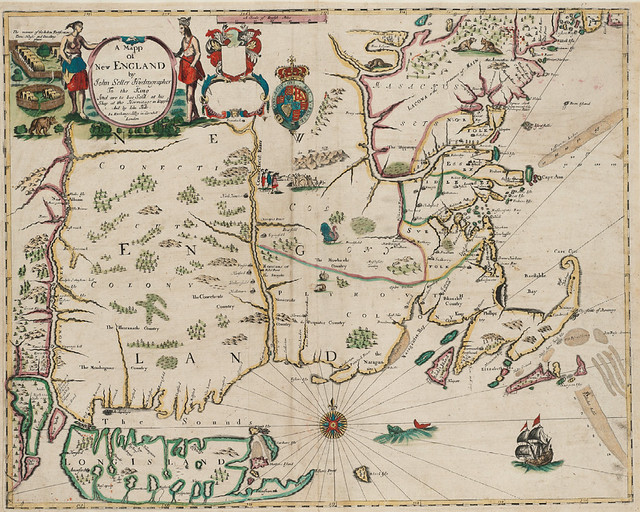
In this 1675 map, trees reveal the British crown's colonial interest in North American natural resources as profitable commodities. Created by John Seller, this map documents the boundaries of the Massachusetts charter of 1628. In the artist's rendering, trees of many shapes and sizes cover the landscape, showing a space that is abundant with both timber and animals (like beavers, rabbits, turkeys, and whales) that were lucrative for global trade. However, the commodification of natural resources put the colonists into conflict with a number of Indigenous tribes who inhabited and maintained the land long before Europeans arrived. In fact, Seller created this map during the first year of King Philip's War: a devastating conflict that erupted after decades of competing land claims between the English, the Wampanoags, and the Narrangasett. The conflict had many environmental factors, including settlers’ livestock destroying Native crops. In his book Changes in the Land: Indians, Colonists, and the Ecology of New England, William Cronon writes that the dispossession of Indigenous populations by Europeans “in New England was as much an ecological as a cultural revolution, and the human side of that revolution cannot be fully understood until it is embedded in the ecological one. Doing so requires a history, not only of human actors, conflicts, and economies, but of ecosystems as well.”